


E-Pusher: modular electric concept for inland navigation


The E-Pusher is a fully electric pusher tug by KOTUG, developed for zero-emission freight transport on inland waterways. The first E-Pusher was commissioned in 2023 for transporting cocoa beans between the port of Amsterdam and Cargill's production site in Zaandam. The concept is now also deployed for transporting sand between the Maasvlakte and Rotterdam.
Structured differently
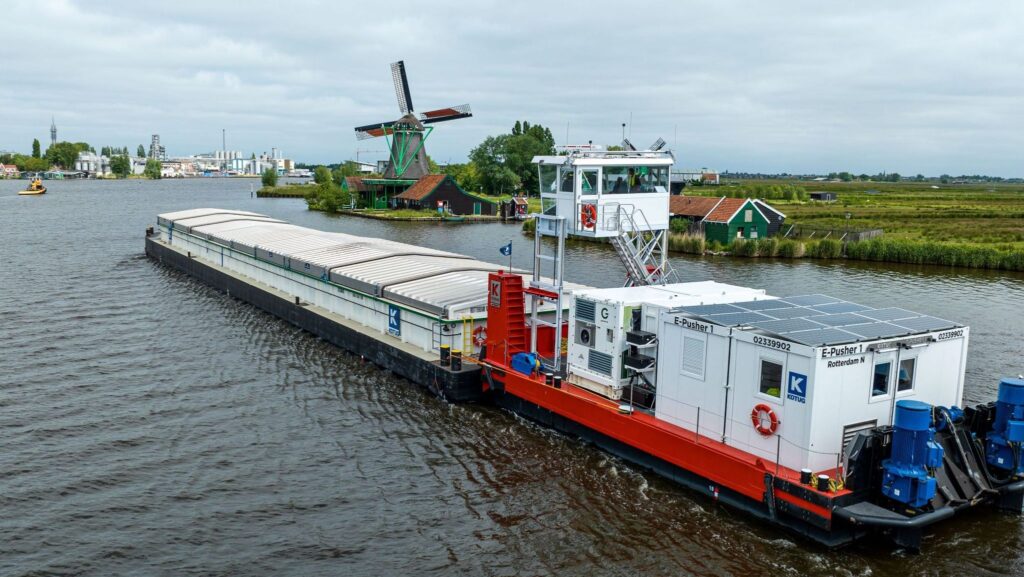
The E-Pusher differs clearly in construction from a traditional pusher tug. The vessel consists of a steel frame with buoyancy elements made of high-grade polyethylene. The electric propulsion and power supply have a modular design, allowing the layout to be adapted to various operational profiles and applications.
KOTUG developed various versions of the concept, ranging from a compact CityBarge to larger S, M and L variants. The energy supply can also be tailored to the operation. Standardisation plays an important role in making such zero-emission solutions applicable on a larger scale. Within Condor, work is therefore underway with the sector on technical standards to support further scaling up. Read more about Condor's approach.
From concept to daily operation
In 2023, the first E-Pusher type M entered service for Cargill. The E-Pusher 1 transports cocoa beans between the port of Amsterdam and Cargill's production facility in Zaandam. The electricity for the vessel comes from renewable energy. Upon its introduction, Cargill and KOTUG expected this to avoid approximately 190 tonnes of CO₂ emissions annually.
Meanwhile, the concept is also being deployed for other goods streams. For instance, an E-Pusher M is sailing for the Rotterdam-based company ROS for the transport of sand between the Maasvlakte and Rotterdam. This version features a battery container with a capacity of 1.68 MWh. Furthermore, the operation utilises a 1 MW fast charger based on the Megawatt Charging System (MCS), which allows the battery to be charged quickly during the logistics operation.
With this, the E-Pusher demonstrates that the electrification of inland shipping is not just about choosing an alternative energy source. The vessel's design, the shore-based charging infrastructure and the operational sailing profile must also be aligned.
For further scaling up, sufficient charging infrastructure therefore remains an important precondition. Condor is therefore working with market parties on concrete locations, demand aggregation and business cases to accelerate the development of zero-emission infrastructure. Read more about the working group approach for infrastructure. It is precisely the combination of ship, energy supply and infrastructure that ultimately determines where battery-electric sailing can be implemented both practically and economically.