


Finance accelerator
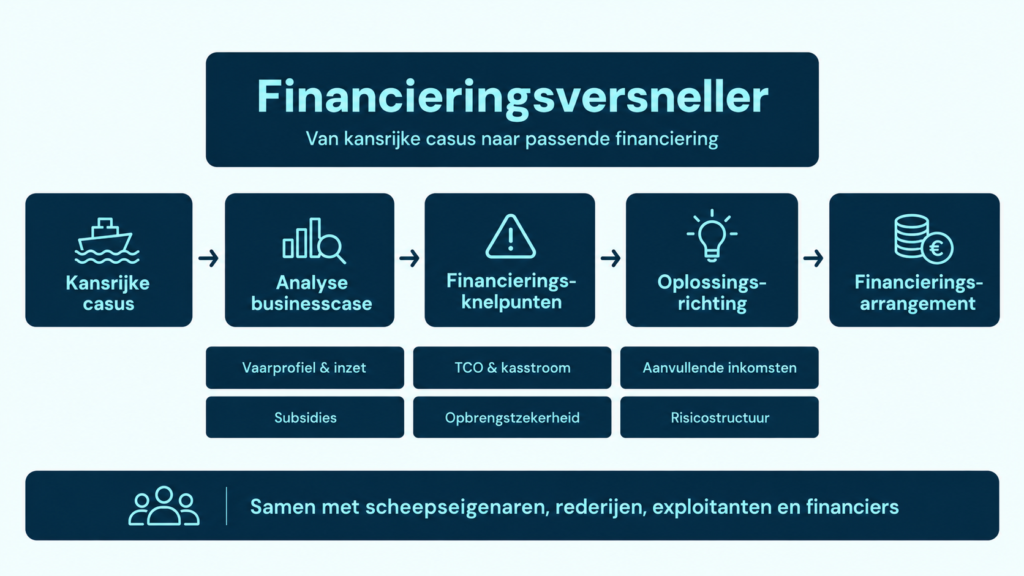
Do you see opportunities in zero-emission shipping, but are struggling to secure financing? We are looking for shipowners, shipping companies and operators — with or without a concrete case. Through the financing accelerator, we work on cases that are economically viable, but where the financing is getting stuck.


From promising case to funding
Zero-emission sailing is financially closer for a section of inland shipping than is often thought. From our analysis for example, it appears that battery-electric navigation can already be competitive with diesel for certain operational profiles. Even so, financing often proves to be a major hurdle in practice. That is why Condor is focusing its funding accelerator for cases that are economically viable, but where the financing is not yet sorted out.
Within the financing accelerator, we look at the issue from multiple angles. Among other things, we look at:
- Vessel profile and deployment
- TCO and cash flow
- Additional income such as EREs and CO₂ insetting
- Guaranteed yield
- Available subsidies
- Risk structure of the financing. Both banks and alternative financiers will be involved in this
Thus we look for solutions that are more difficult to achieve individually and we advance a promising business case towards actual financing.
Do you have a case study?
Condor ZE is looking for shipowners, shipping companies and operators who already have a concrete investment plan, but are unable to secure financing. Parties that do not yet have a developed case, but want to investigate whether zero-emission sailing is feasible for their ship, route or contract basis, can also apply. Get in touch with us to discuss your case.
Scope
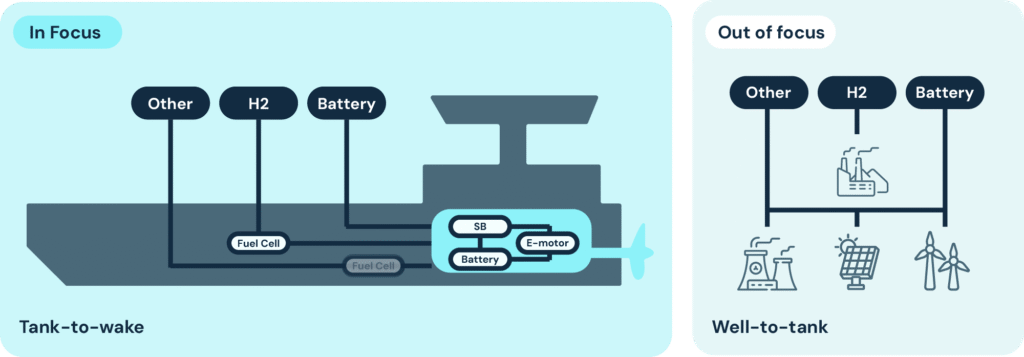
We focus on the tank-to-wake phase: the energy available on board and how it is used for vessel propulsion. This includes fuel and energy carriers such as hydrogen, batteries and alternative fuels, as well as their conversion and use through technologies like fuel cells, batteries and electric motors.
More information?
The pace varies per segment
Whether zero-emission sailing is feasible depends on the ship, sailing profile, energy requirement and the possibility of charging or swapping. For ships operating on short, fixed routes, the lifecycle costs of a (battery-electric) vessel are already close to those of diesel. For longer distances and heavier shipping, that point lies further in the future.
Hydrogen has potential for inland shipping and the technology is proven. However, the cost price is currently still high: only when production, infrastructure and scale develop further will hydrogen become a competitive alternative. This is particularly the case in longer and heavier shipping, where battery-electric has less reach. That is why we are already working on the standardisation of hydrogen tank containers.
Especially in that longer and heavier shipping sector, hydrogen remains part of the solution, which is why we are already working on the standardisation of hydrogen tank containers.