Accelerating the transition to zero emission inland shipping
Condor is an industry-wide programme aimed at reducing the overall cost of zero-emission inland navigation, enabling at least 150 investment decisions before 2030.
Sector-wide programme
Inland shipping plays a key role in making logistics chains more sustainable. Biofuels, digitalisation and innovations are already making the sector cleaner, but true zero-emission goes a step further: no more CO₂, nitrogen, particulate matter or noise. This requires a fundamental shift from combustion engines to electric propulsion, via retrofitting or newbuilds.
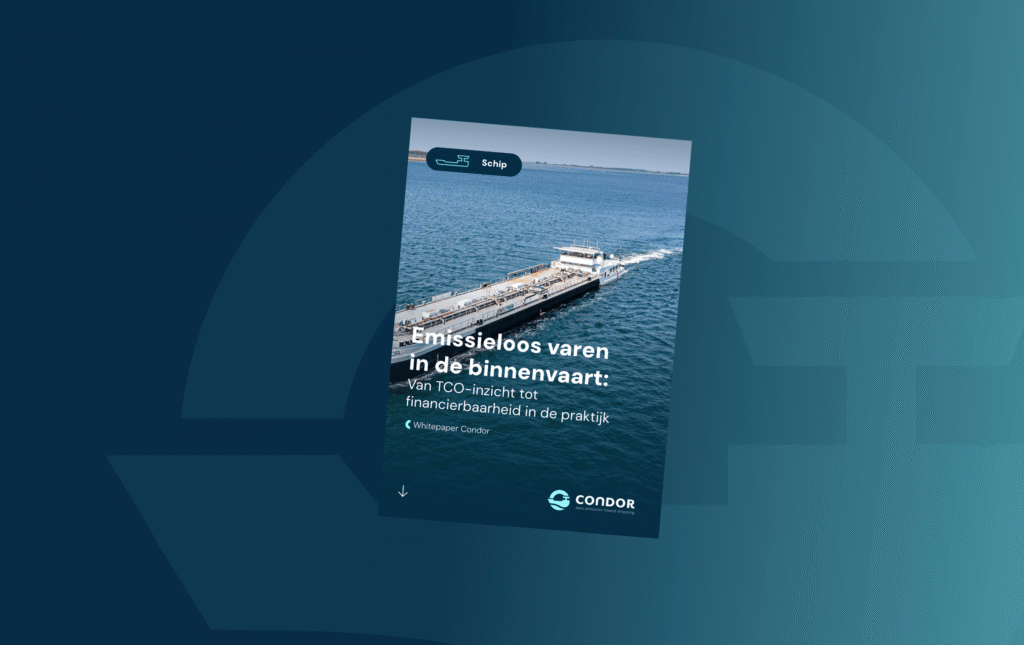
For part of the fleet, that step is closer than is often thought. We have calculated what a ship costs over its entire lifespan — purchase, energy, maintenance and charging combined, over a period of twenty years — and validated those results with the EICB. For a battery-electric ship with a short and fixed sailing profile, for the majority of the fleet, from 2028 onwards, that works out around the level of diesel.
For ships that travel longer distances, that moment lies after 2030, provided that the main barriers have been removed: financing falling into place, timely available infrastructure, and ways to monetise additional revenues.
With Condor, we are working sector-wide on reducing costs and unlocking new revenue streams. This creates investment certainty and makes zero-emission sailing a logical and achievable choice.
Partners


Economically viable, not yet bankable
Our research shows that when calculated over the entire lifespan, the investment pays off. However, a bank calculates over the term of the loan (five to ten years). It is precisely in those first years that the costs of a zero-emission vessel are highest, and that is exactly the period in which the loan must be repaid. This creates the financing gap: an investment that is justified over the lifespan of the ship, but not within the timeframe that a bank looks at.
In virtually every case, it stalls on this, and a subsidy doesn't solve it. That lowers the purchase price, but does little to change the costs in the years that follow. In the funding accelerator that is why, on a case-by-case basis, we are working on the combination that can indeed close the gap: longer contracts, additional securities, public instruments and a better distribution of risk.
Industry objective:
of the 150 investment decisions in zero emission inland vessels made by the industry.
Our course
01 Mission
Condor makes investment in zero emission inland vessels possible by reducing the Total Cost of Ownership while at the same time stimulating market demand. We focus on three fronts: the vessel, the infrastructure and the market. In doing so, we are working towards at least 150 investment decisions in zero emission inland vessels before 2030.
02 Vision
By 2050, Dutch inland shipping will be almost entirely zero emission – without CO₂, nitrogen or particulate matter, and with minimal impact on climate and local environments. In this way, inland shipping will remain the silent, clean and reliable driving force behind Dutch and European freight transport.
With & for the market
Condor consists of a coalition of more than fifty parties – ranging from shipbuilders and technology companies to shipping lines, logistics service providers, financiers, insurers, provinces, port authorities and terminals. To make zero-emission shipping possible, multiple bottlenecks must be solved in a coherent manner: reference standards, financing, timely available infrastructure and additional revenues.
In working groups, case sessions and partner meetings, we bring together the parties who can take each issue further.
The Dutch government aims to have 150 zero emission inland vessels in operation by 2030, emitting no harmful substances.
Programme themes
Vessel
We develop industry standards and new financing models that make investments in zero emission inland vessels both feasible and attractive.
Infrastructure
Together with our partners, we work on a systematic development and financing of zero emission infrastructure.
Market
We start with promising market segments to quickly stimulate demand for zero emission inland shipping.
Agenda
Within the programme, we work on the spearheads that make investments in zero emission vessels feasible and attractive. In the agenda you will find meetings and consultations around the three central themes: vessel, infrastructure and market.
Agenda
In the agenda you will find the meetings and consultations surrounding the three themes: vessel, infrastructure and market. Think of working groups, case sessions of the financing accelerator and partner meetings.
Advisory Council
- 11.00-13.00
- Provincial House The Hague
Advisory Council
- 11.00-13.00
- Logistics House
Partner meeting
- 15.00-17.30
- World Port Centre (Wilhelminakade 901 Rotterdam)
Working group on containers: sand & gravel
- 10.00-12.00
- Groothandelsgebouw, Rotterdam