Whitepaper - RED3 & ERE's

What do RED III and EREs mean for emission-free boating?

The new RED III regulations offer opportunities to make emission-free shipping more financially attractive. But how much is the value of emission reduction units (ERE’s) and how can it be used to make investments in inland shipping possible? On the initiative of CONDOR and the Topsector Logistics sector, research has been conducted into this.

The new RED III regulations offer opportunities to make emission-free shipping more financially attractive. But how much is the value of emission reduction units (ERE) and how can it be used to make investments in inland shipping possible? On the initiative of CONDOR and the Topsector Logistics sector, research has been conducted into this. The results have now been published in a new white paper.

Since January 1, 2026, the Fuel Transition Obligation (BTV) has been in effect in the Netherlands, as a result of the European RED III directive. This has replaced the previous HBE system with a system that focuses on CO₂ reduction. Within this new system, parties that supply renewable energy can generate and trade EREs.

For inland navigation, this offers new opportunities. The revenues from EREs can contribute to reducing the costs of emission-free navigation. At the same time, the market has yet to develop fully and there is uncertainty about its future value.

EREs can make an important contribution to the business case

The whitepaper examines how the ERE market works and what this means for investments in electric and hydrogen-powered shipping.

Financial models have been used to calculate the impact ERE revenues can have on the feasibility of these investments. The results show that EREs can make a significant difference.

In one of the examined scenarios, the financial space for electric shipping is reduced by more than 40% when ERE revenues fall away after 2030. This underscores how important clarity about future regulations and revenues is for investors. And how important it is that ship owners can (also) benefit from this value.

Collaboration within the chain is essential

In addition to the financial impact, the whitepaper examines how ship owners, energy suppliers and financiers can work better together to incorporate this value into the ship’s business case. Two models have been developed to allocate the value of emission reduction and to limit investment risks.

The researchers advocate, among other things, clarity regarding the regulations towards 2040, more transparency regarding ERE prices and better coordination with neighboring countries.

For CONDOR, these recommendations directly align with the work to reduce the costs of emission-free shipping, utilize additional revenues, and enable investments in the sector.

Read the whitepaper

The full whitepaper on the tradability of emission reduction units is available via the Topsector Logistics initiative.

View and download the whitepaper: https://topsectorlogistiek.nl/kennisbank/verhandelbaarheid-van-emissiereductie-eenheden
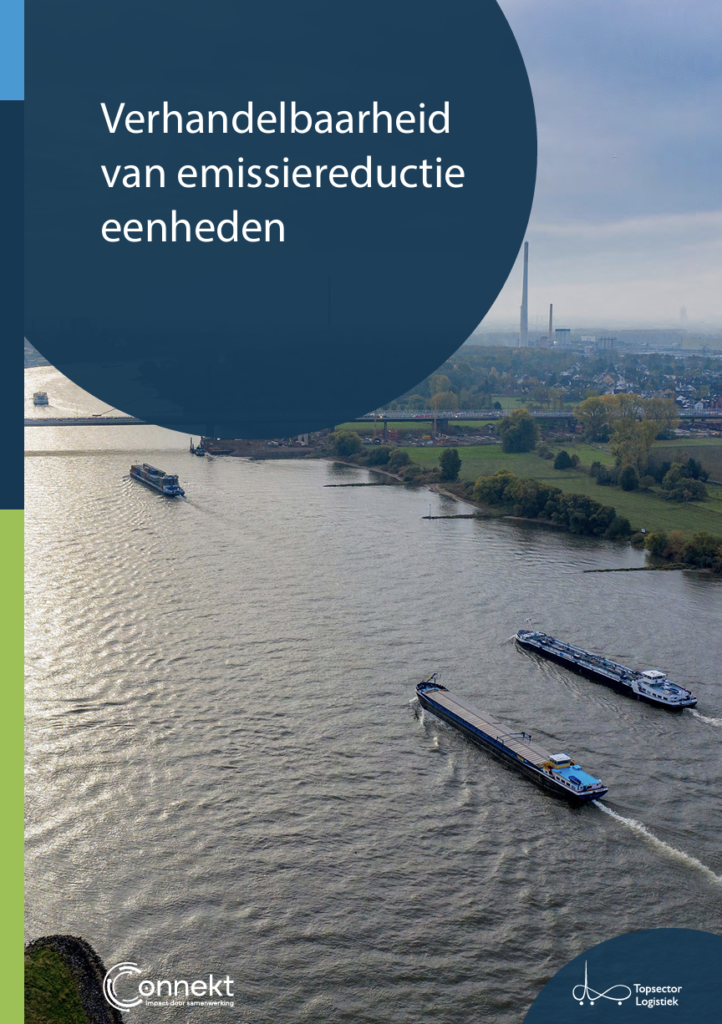
Emissiereductie eenheden binnenvaart document

View the document here

About Rianne de Vries

With in-depth knowledge of sustainable propulsion technologies, alternative fuels and infrastructure solutions for the inland navigation and maritime sector, I actively contribute in various ways to accelerating the transition to zero-emission transport. I use my experience in ports, maritime sector combined with a pramatic approach to create system conditions for large-scale sustainability of inland navigation.

About Renze Boersema

In this project, I focus on developing and validating the financial and strategic rationale for zero-emission boating. Specifically, I visualise the business case for both hydrogen and battery-electric solutions, with an eye for operational and economic feasibility. I also conduct discussions with banks to formulate clear financing requirements that match the specific characteristics of sustainable inland vessels. Finally, I provide an overview of available subsidy schemes and support options, so that the sector can make optimal use of incentives for sustainability.

About Johan Gille

From the Port of Rotterdam Authority, Johan focuses on a reliable, future-proof and sustainable waterway network. After all, inland shipping is the lifeline for the port. He has a broad network in government, provinces and inland ports and promotes the development and standardised deployment of instruments that governments can use to support the move to zero emission inland shipping.

About Irma Belgraver

Irma focuses on developing financing arrangements to support zero-emission shipping. From a strong network within the inland navigation sector, government organisations, industry associations and knowledge institutes, she initiates collaborations to strengthen the economic feasibility of sustainability. In the coming period, strategic options will be explored to optimise the business case.

About Eric Warners

Eric Warners worked in the port of Amsterdam for more than seven years on initiatives to make shipping and industry more sustainable. He has been involved with Condor since October 2024. Eric has always gericht on complex issues that can only be solved through (public-private) cooperation. For the past decade, his focus has been entirely on the maritime and industrial sectors.

About Wouter Vuijk

Within the Port of Rotterdam Authority, Wouter works on making inland navigation more sustainable, with a specific focus on the transition to emission-free sailing. At Condor, he supervises the process in which, in cooperation with the sector, technical standards are being developed. This removes an important threshold for this transition.
