

Approach
The Condor programme enables investment in zero emission inland vessels by lowering total costs and stimulating demand.


Themes
Within the Condor programme, integral collaboration on concrete projects takes place from three main themes – ship, infrastructure and market: from reference designs and financing structures to enabling timely available infrastructure and realising additional revenues in the form of emission reduction units (ERUs) and carbon insetting.
Click below on one of the themes for further explanation.


Vessel
In this workstream, we are reducing the costs of a zero-emission ship and bridging the gap to financing.
- Reference designs – the design for the GH2 tank container has been finalised; the battery and fuel cell are being developed in monthly working groups with industry stakeholders. Standardisation reduces investment and accelerates certification.
- Financing – the cost model with which we project vessels over twenty years is kept up to date, in cooperation with the EICB. In the financing accelerator, an entrepreneur can submit a vessel that is viable in the long term, but for which financing cannot be secured. Financiers, public bodies and market players then examine together what is required.

Infrastructure
In this workstream, we are reducing the costs of a zero-emission ship and bridging the gap to financing.
- Reference designs – the design for the GH2 tank container has been finalised; the battery and fuel cell are being developed in monthly working groups with industry stakeholders. Standardisation reduces investment and accelerates certification.
- Financing – the cost model with which we project vessels over twenty years is kept up to date, in cooperation with the EICB. In the financing accelerator, an entrepreneur can submit a vessel that is viable in the long term, but for which financing cannot be secured. Financiers, public bodies and market players then examine together what is required.

Market
Within this workstream, we convert the emissions saved by a vessel into revenue for the owner.
- Here are the CO₂-insetting – together with Topsector Logistiek and Darel, we are investigating how inland waterway energy-saving technologies can strengthen the skipper's business case. With partners, we are designing an in-setting tool that enables shippers to account for CO₂ reductions within their own supply chain. The first step, together with All Chiefs and Topsector Logistiek, is a standardised method for calculating emission reductions.
- Monetising clean air – together with the Clean Air Agreement we are exploring whether the reduction of particulate matter and NOx can also be monetised.
Scope
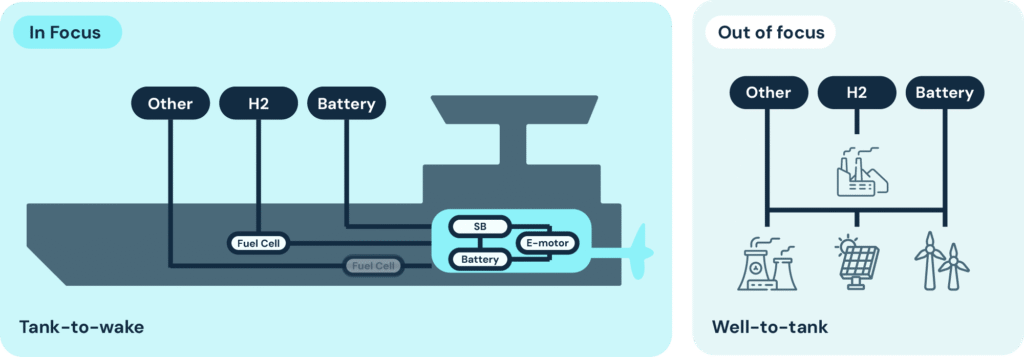
Condor does not develop propulsion technology itself. What we do, however, is define the scope of the programme: the tank-to-wake phase – the energy available on board and how it is deployed for the propulsion of the vessel. In doing so, we include fuel and energy carriers such as hydrogen, batteries and alternative fuels, as well as the conversion and use via, for example, fuel cells, battery packs and electric motors.
Role of Condor
Condor does not make investment decisions itself and is not an owner or operator. We bring parties together around a shared challenge, support the analyses, monitor progress and prepare decision-making. The decision remains with market parties and public owners. It is precisely that independent position that makes this possible.
Scope
We focus on the tank-to-wake phase: the energy available on board and how it is used for vessel propulsion. This includes fuel and energy carriers such as hydrogen, batteries and alternative fuels, as well as their conversion and use through technologies like fuel cells, batteries and electric motors.
The pace varies per segment
Whether zero-emission sailing is feasible depends on the ship, sailing profile, energy requirement and the possibility of charging or swapping. For ships operating on short, fixed routes, the lifecycle costs of a (battery-electric) vessel are already close to those of diesel. For longer distances and heavier shipping, that point lies further in the future.
Hydrogen has potential for inland shipping and the technology is proven. However, the cost price is currently still high: only when production, infrastructure and scale develop further will hydrogen become a competitive alternative. This is particularly the case in longer and heavier shipping, where battery-electric has less reach. That is why we are already working on the standardisation of hydrogen tank containers.
Especially in that longer and heavier shipping sector, hydrogen remains part of the solution, which is why we are already working on the standardisation of hydrogen tank containers.